
Worth knowing
- Tall fescue should be mowed at 3 to 3.5 inches and never below 2.5 inches.
- Cool-season grasses are best seeded from mid-August to October 1; warm-season sod roughly April to July 1.
- A 40-pound bale of pine needles typically covers about 100 square feet to a 2-inch depth.
Buyers form an opinion before they reach the front door, and online they form it from the first exterior photo. In the National Association of REALTORS® 2025 Profile of Home Staging, improving curb appeal was the third most common recommendation sellers’ agents made, at 77 percent, after decluttering and cleaning. In North Carolina, the challenge is timing: what the lawn and shrubs look like depends heavily on the month you list.
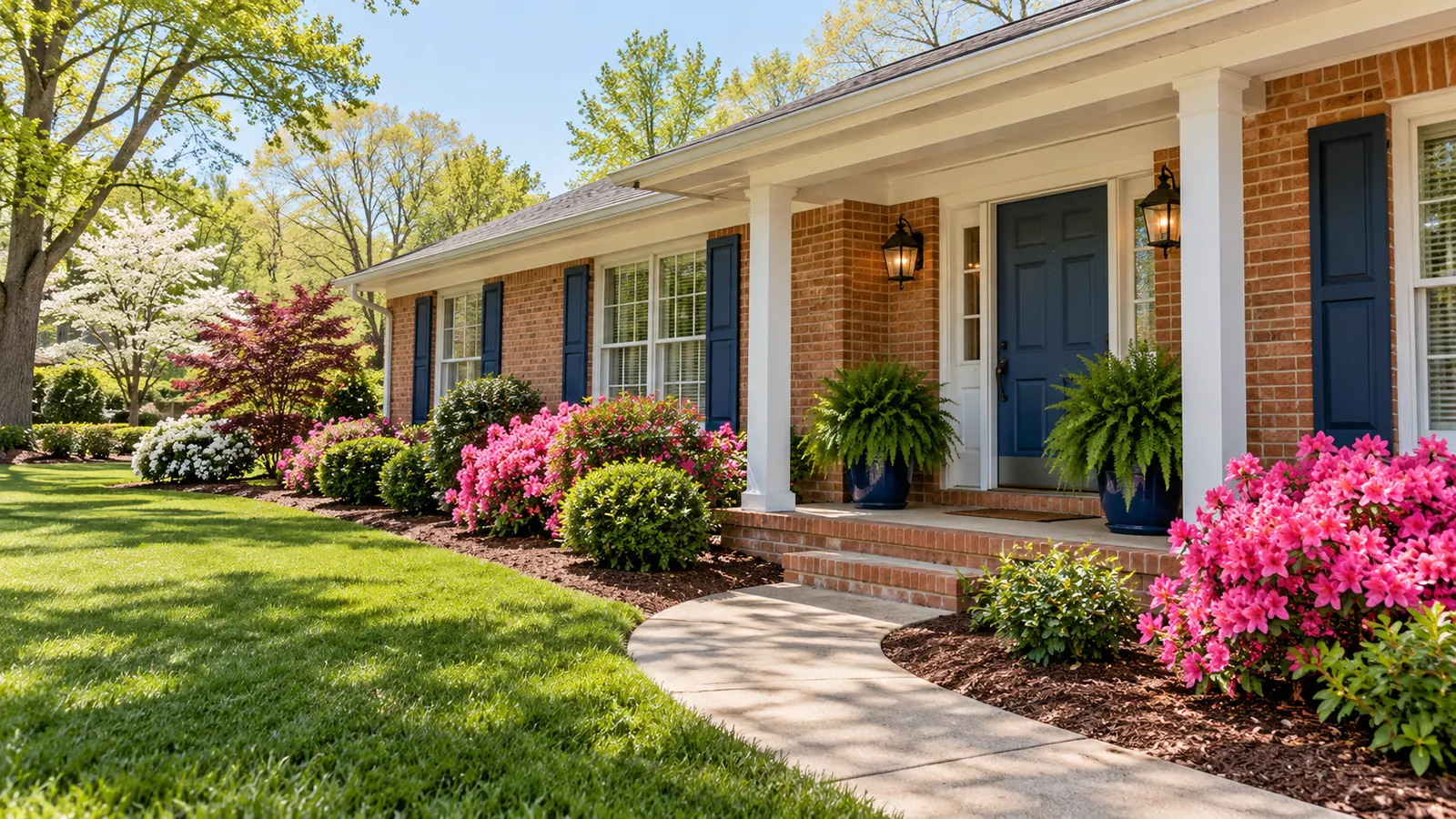
Know which grass you have
NC State Extension’s Carolina Lawns guide divides the state’s lawns into two groups. Cool-season grasses, mainly tall fescue in the piedmont, grow best in spring and fall and stay reasonably green in winter. Warm-season grasses such as bermudagrass, zoysiagrass, centipedegrass and St. Augustinegrass grow best in summer, go dormant at the first heavy frost, turn brown and green up slowly the following spring.
That difference shapes your listing plan. A fescue lawn can look good in a March listing; a bermuda lawn will still be tan. Neither is a defect, but you should know what buyers will see.
| Grass | Mowing height (NC State Extension) | Best time to establish |
|---|---|---|
| Tall fescue | 3 to 3.5 inches, never below 2.5 | Seed mid-August to October 1 |
| Bermudagrass | 0.75 to 1 inch with a reel mower; 1 to 2 inches with a rotary mower | Sod about April to July 1 |
| Centipedegrass | Mow when it reaches 1 inch; no higher than 2 inches | Sod about April to July 1 |
| St. Augustinegrass | 2.5 to 4 inches | Sod about April to July 1 |
Extension warns that spring seeding of cool-season grass is often less than satisfactory because seedlings do not have time to root before summer. If your fescue lawn has bare spots and you are listing in spring, sod is the faster fix; cool-season sod can go down any time in the cooler part of the growing season when the ground is not frozen. Warm-season sod will not root until the soil has been above 55 °F for several weeks.
Mowing too short is the most common way to make a lawn look worse before photos. Raise the mower deck to the recommended height a few weeks before listing so the grass thickens.
Beds: edge, weed and mulch
Fresh mulch makes beds look finished in photos. N.C. Cooperative Extension in Lee County points out that North Carolina has a large industry producing pine needle mulch, that longleaf needles are the most prized and that a 40-pound bale typically covers about 100 square feet to a 2-inch depth. The same article addresses a common worry: soil scientists at NC State said the acidifying effect of pine needles is no greater than that of other mulches, because soils buffer the change.
- Edge beds cleanly where they meet the lawn.
- Pull weeds before mulching; mulch suppresses new weeds but does not kill established ones.
- Keep a uniform 2-inch layer and pull mulch back from the house foundation.
- Remove leaf piles and old lumber near the house, which also helps the termite inspection.
Azaleas and foundation shrubs
Azaleas are a fixture of North Carolina front yards. The NC State Extension plant toolbox notes that they prefer moist, well-drained, acidic soil in dappled shade, with protection from afternoon sun that can scorch the leaves, and that they do not tolerate dense clay or poor drainage. It also lists lace bugs and other insects among common problems and notes frequent deer damage. Before listing, prune out dead wood and check the leaves; bleached or stippled foliage is easy to spot in close-up photos.
The front door and porch
The door is in nearly every exterior photo. Clean or repaint it, replace a worn doormat, polish or replace the house numbers and make sure the porch light works. A pair of potted plants frames the entry without blocking it. Sweep cobwebs from porch ceilings and corners, and wash the walkway.
Timing by city
NOAA’s 1991-2020 climate normals show how similar the three big piedmont airports are, and how hot mid-summer gets for outdoor work.
| Station | April avg high | July avg high | October avg high | Wettest month |
|---|---|---|---|---|
| Charlotte Douglas Intl | 73.2 °F | 90.3 °F | 73.3 °F | August, 4.35 in |
| Raleigh-Durham Intl | 72.7 °F | 90.8 °F | 73.0 °F | September, 5.15 in |
| Greensboro Piedmont Triad Intl | 71.0 °F | 88.5 °F | 71.0 °F | September, 4.59 in |
For most sellers that points to spring or early fall for yard projects. If you list in summer, water deeply in the weeks before photos and schedule outdoor work for mornings.
Yard waste
Pruning and cleanup create debris. Charlotte collects yard waste at the curb once a week when it is prepared to the city’s requirements and turns it into mulch and compost. Raleigh’s Special Load pickup takes up to 24 biodegradable yard waste bags for a fee, but not loose leaves or limbs longer than five feet. Plan the cleanup a week ahead of your photographer so the curb is clear.
Curb appeal is one part of the plan in our The North Carolina Home Staging Checklist: Six Weeks From Cluttered to Listed. For homes that will sit empty while listed, see Staging a Vacant Home in North Carolina: Furniture, Moisture and the Empty-House Checklist, since an unattended yard needs a mowing schedule.